Halifax Withdrawal Restrictions
Surface Through Media Reporting
With Many Customers Never Officially Informed

Halifax Withdrawal Rules & Brand Retirement
What Customers Were Not Told
In July 2026, Halifax issued new withdrawal guidance stating that:
“For larger withdrawals, availability may be limited.” “You may be asked to give identification and supporting documentation.” “We may ask questions about your withdrawal.” “We may request information to confirm the purpose of the withdrawal.”
These conditions were not disclosed to customers when accounts were opened, nor applied consistently across branches. CURB has documented multiple cases where customers were:
- told they could withdraw up to £880 from ATMs
- given verbal assurances by branch staff
- never informed of a £300 universal limit
- questioned or pressured during lawful withdrawals
- asked to justify personal spending
- asked for documentation without cause
- subjected to safeguarding language during routine transactions
Halifax’s new wording appears after:
- customer complaints
- FO escalation
- safeguarding concerns
- procedural inconsistencies
- brand retirement announcements
- migration notices to Lloyds
- public scrutiny of withdrawal practices
This timing is significant.
- Retrospective Justification of Undisclosed Conditions
Halifax’s new guidance attempts to retro‑justify behaviour that was never disclosed at account opening. Customers were not informed that:
- withdrawal availability could be restricted
- documentation could be demanded
- “purpose of withdrawal” could be questioned
- limits could be applied inconsistently
- safeguarding language could be used during financial transactions
These conditions now appear in public guidance only after complaints were raised.
- Brand Retirement & Liability Transfer
Halifax will be retired as a standalone brand by October 2026. All customer data, complaints, and legal obligations transfer to Lloyds Banking Group.
This includes:
- safeguarding complaints
- procedural complaints
- FO escalations
- GDPR requests
- withdrawal‑related incidents
- internal notes
- branch‑level conduct records
Brand retirement does not erase liability.
- GDPR Requests During Brand Transition
Under UK GDPR, banks must provide:
- all internal notes
- all withdrawal records
- all safeguarding flags
- all fraud flags
- all staff comments
- all internal communications
- all FO correspondence
- all account‑level decisions
Brand retirement does not pause or cancel GDPR rights. If Halifax fails to respond, Lloyds becomes legally responsible.
- Structural Pattern
CURB identifies a consistent pattern across sectors:
- retrospective justification
- policy rewriting after harm
- brand retirement used to tidy inconsistencies
- vulnerability language used incorrectly
- procedural opacity
- narrative control during transition periods
Halifax’s July 2026 withdrawal guidance fits this pattern.
- What Customers Should Know
- Your money is your property.
- Banks cannot impose undisclosed withdrawal conditions.
- Banks cannot demand purpose of withdrawal without cause.
- Banks cannot apply hidden limits.
- Banks cannot use safeguarding language to control finances.
- Brand retirement does not erase complaints.
- GDPR requests remain legally binding.
- FO escalations remain active.
- CURB Position
CURB will continue to monitor:
- withdrawal policy changes
- brand retirement behaviour
- FO escalation handling
- safeguarding misuse
- procedural inconsistencies
- regulatory compliance during mergers
Further updates will be published as Lloyds assumes full control of Halifax accounts.
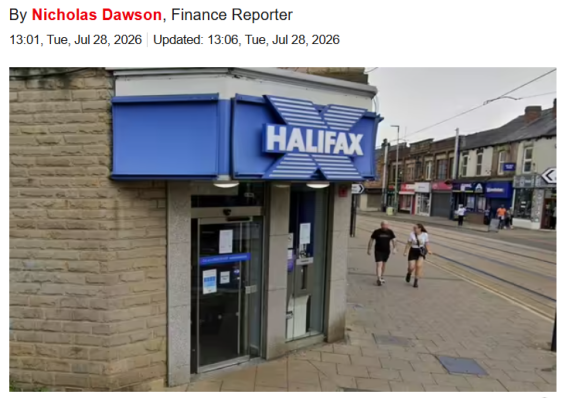
A customer contacted Halifax on social media to ask whether they could withdraw more cash than the ATM limit by visiting a branch. Halifax confirmed that this is possible and explained the conditions.
They stated that customers can withdraw more than their ATM limit in branch. For withdrawals over £300, the customer must use their Chip and PIN card, and staff may ask for identification. Photo ID is required for withdrawals above £5,000.
Halifax’s guidance also says that cash can be withdrawn at any Lloyds, Halifax, or Bank of Scotland branch. The bank notes that customers may need to provide identification for larger withdrawals, and that availability may be limited depending on circumstances.
Halifax also said that, as part of fraud‑prevention measures, staff may ask questions about a withdrawal. This can include requesting information or documentation to confirm the purpose of the withdrawal, and discussing alternative secure ways to make a payment.
The bank added that customers will soon be moved to the Lloyds Bank brand. People will be invited to switch to the Lloyds app and Online Banking over the coming months. No action is required until the invitation arrives, and account details and payments will remain unchanged.
This clarification was published only after complaints, FO escalation, and GDPR challenges — and shortly before Halifax’s brand retirement.
Design & Copyright Owner Maureen Booth-Martin (MBM) © All rights reserved
| Visitor Counter: | |||||||
 |  |  |  |  | | ||